


Monitoring the transformation of Hilton Salwa Beach Resort and Villas through multi-temporal satellite imagery and automated building detection.
Overview
The southwestern coastline of Qatar has undergone significant development, with large-scale tourism infrastructure reshaping previously undeveloped coastal landscapes.
This case study examines the transformation of the Hilton Salwa Beach Resort and Villas site between 2013 and 2016 using multi-temporal satellite imagery and automated building detection. The comparison documents how a largely untouched desert coastline was transformed through marina construction, shoreline modification, villa development, and supporting infrastructure.
The analysis demonstrates how satellite imagery can monitor the scale, pace, and spatial distribution of construction activity, providing valuable information for coastal development assessment and infrastructure monitoring.
Satellite-Based Change Detection
Monitoring Coastal Development Through Satellite Imagery
The assessment compares satellite observations from 2013 and 2016 to identify changes in land cover, shoreline geometry, construction footprints, and supporting infrastructure.
The 2013 imagery establishes the pre-development baseline, while the 2016 imagery reveals the scale of construction and the emergence of a planned resort complex. Automated building detection complements the visual assessment by identifying individual structures and assigning confidence scores.
Coastal Transformation: 2013 vs 2016
From Open Desert Coastline to Resort Development
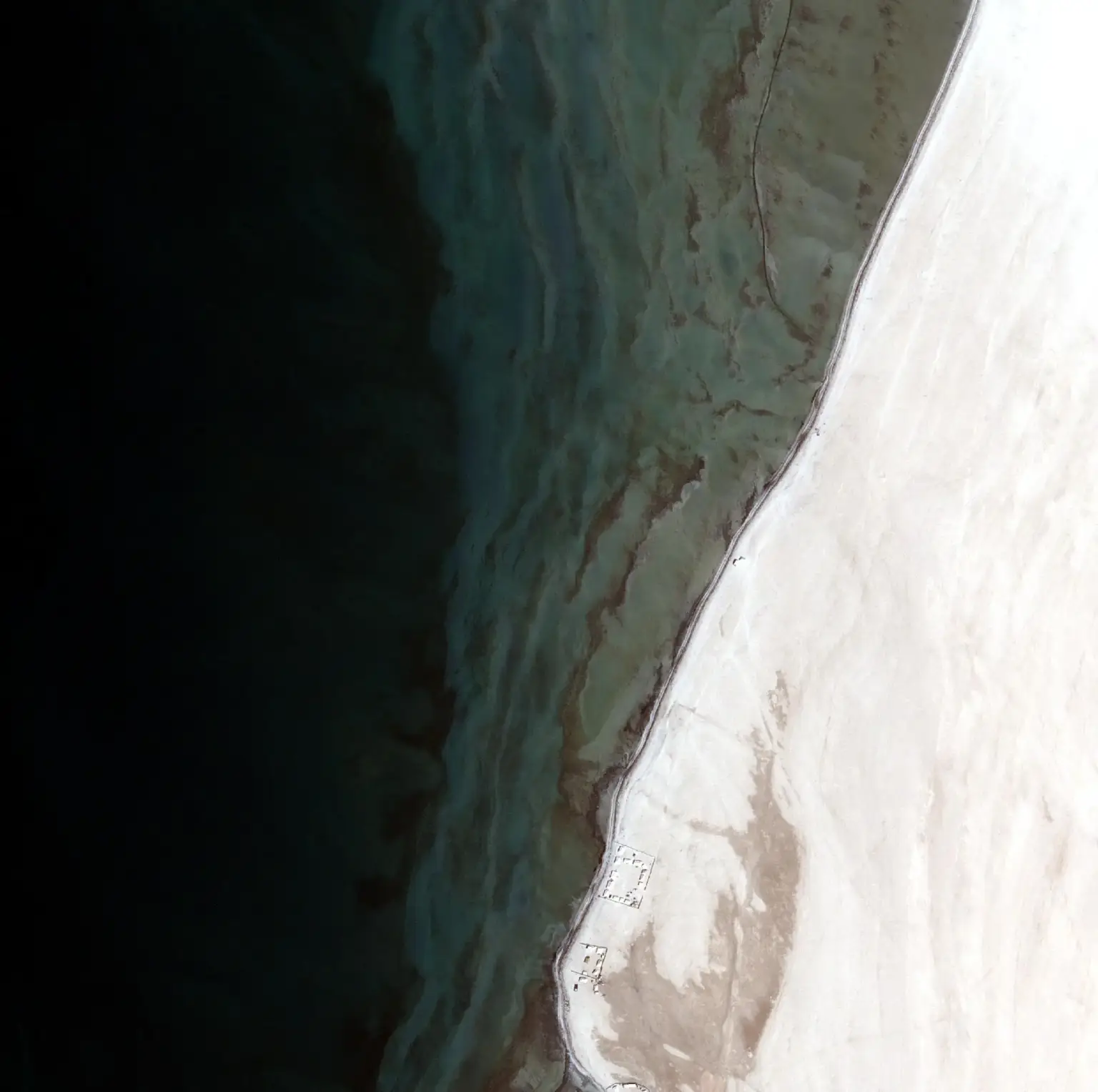
2013 - Pre-Development Baseline
The 2013 satellite imagery shows a largely undeveloped coastal landscape. Flat desert terrain extends toward a natural, irregular shoreline, with no established road network, major structures, or engineered coastal features visible.
Faint rectangular traces near the lower part of the study area may indicate early site preparation, but the overall landscape remains substantially undeveloped.
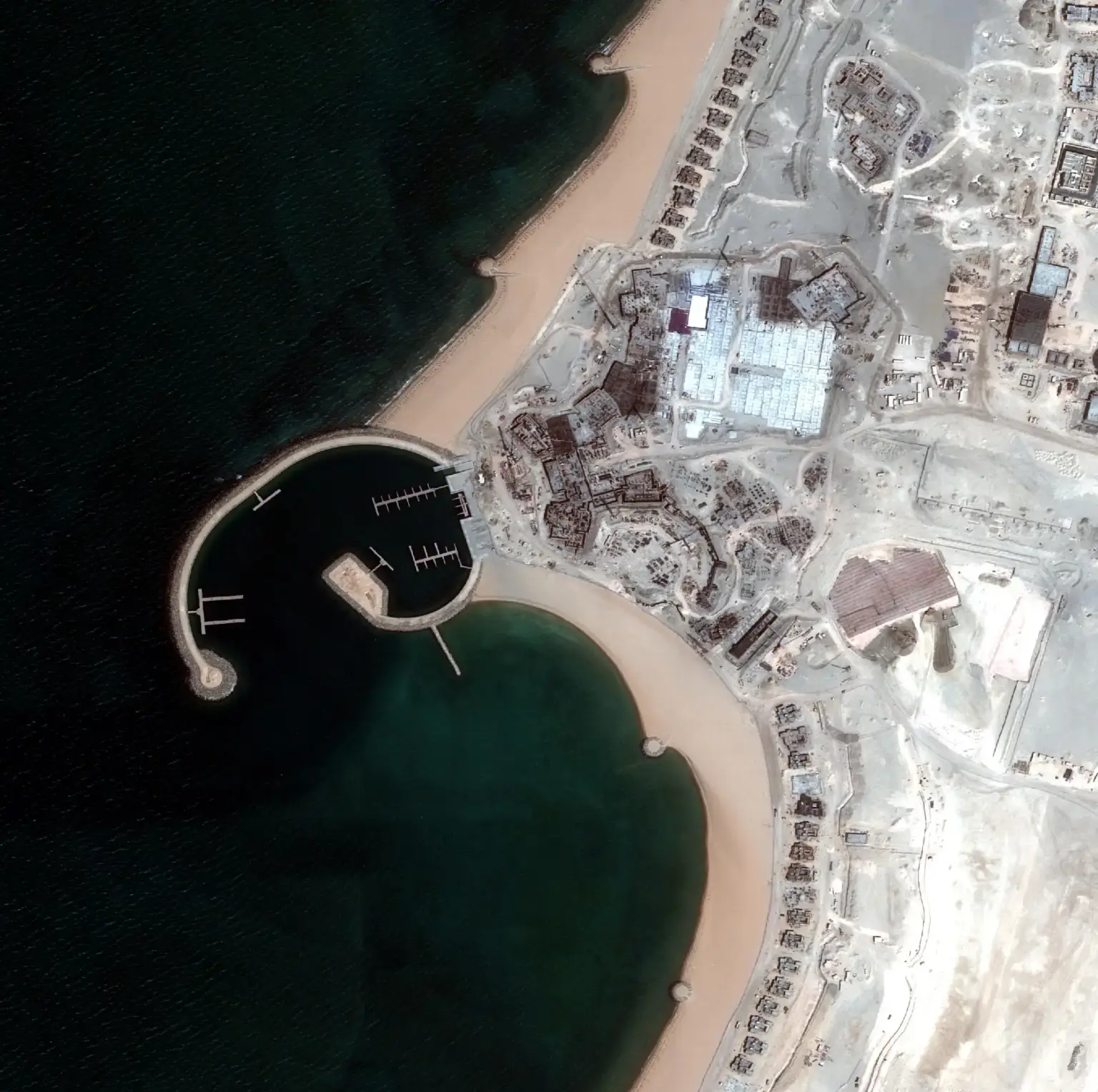
2016 - Development and Coastal Engineering
By 2016, the site had undergone extensive physical transformation. A large semi-circular breakwater and protected marina basin were visible, alongside modified beachfront areas, rows of villas, major resort structures, and an established internal road network.
The imagery also reveals eastern utility and logistics areas supporting the broader development.
Major Development Observations
Key Coastal and Infrastructure Changes
- Marina and Breakwater Construction : A semi-circular breakwater was developed to enclose a protected marina basin, substantially altering the natural shoreline.
- Beachfront Villa Development : Regularly arranged villa rows emerged along the newly developed coastline, indicating planned and standardised construction.
- Central Resort Construction : Large building footprints, curved architectural forms, and supporting structures became visible inland from the marina.
- Roads and Utility Infrastructure : Internal roads, warehouses, and utility buildings were developed to support construction and future resort operations.
Automated Building Detection
Automated Building Footprint Detection
Automated building detection was used to identify structures across the developed site. The model detected 188 building footprints, with confidence scores ranging from 0.500 to 0.946.
The detections were grouped into five confidence categories, allowing the analysis to distinguish more clearly defined buildings from smaller, partially obscured, or incomplete structures.


Building Detection Results
Detection Confidence Distribution
| Confidence Range | Category | Buildings |
|---|---|---|
| 0.500–0.580 | Dark Purple | 38 |
| 0.580–0.685 | Cyan | 37 |
| 0.685–0.785 | Lime Green | 39 |
| 0.785–0.893 | Orange | 36 |
| 0.893–0.946 | Dark Red | 38 |
| Total | Detected Structures | 188 |
Detected Building Footprints by Confidence Category
Number of detections in each confidence interval
The higher-confidence detections are concentrated around larger and more clearly defined structures, including the central resort buildings and utility facilities. Lower-confidence detections occur around smaller buildings and areas of active construction, where incomplete roofs and exposed materials introduce additional uncertainty.
Key Findings
Key Findings from the Change Detection Analysis
- Rapid Coastal Transformation : The satellite imagery documents extensive development between 2013 and 2016, including shoreline modification, marina construction, and large-scale building activity.
- Coordinated Infrastructure Development : Regular villa layouts, internal roads, utility buildings, and the central resort complex demonstrate multiple interconnected construction activities.
- Quantifiable Building Development : Automated detection identified 188 building footprints, providing a measurable record of structural development alongside the visual satellite analysis.
Conclusion
The Hilton Salwa Beach Resort and Villas development provides a clear example of how satellite imagery can document rapid coastal transformation over a relatively short period.
Between 2013 and 2016, the study area changed from a largely undeveloped desert coastline into a major construction site with engineered coastal structures, accommodation facilities, transportation networks, and supporting infrastructure.
By combining multi-temporal satellite imagery with automated building detection, the assessment demonstrates an effective approach for monitoring large-scale development. Such methods can support infrastructure planning, construction monitoring, land-use assessment, and environmental change documentation, particularly where regular ground-level observations are difficult.